Land of Ideas. Contact us

Rogers–Sorensen in Romania: What the HASC Delegation’s visit reveals about the Emerging Strategic Equation between Bucharest and Washington
Liliana Grosaru-Filip
President, Political Research Group
The visit to Romania, from 28 to 31 August 2026, by a delegation of the United States Congress led by Representative Mike Rogers (R-Alabama), Chairman of the House Armed Services Committee (HASC), together with Representative Eric Sorensen (D-Illinois), a member of the same Committee, deserves to be considered beyond the sequence of official meetings.
The timing matters. Washington is reassessing the posture of U.S. forces in Europe; Allies are being pressed to turn higher defense spending into usable military capability; and Congress is simultaneously debating the scale of the U.S. presence on the continent, the rebuilding of the defense industrial base, and the global allocation of American military resources.
Romania has a direct and substantial interest in this debate because its outcome will affect national security, the credibility of deterrence on NATO’s Eastern Flank, and the future shape of the bilateral Strategic Partnership.
For that reason, the Rogers–Sorensen visit should not be viewed as an isolated diplomatic episode. It followed months of intensified engagement between Bucharest and Washington and, importantly, a separate mission to the United States by Presidential Adviser for National Security Marius Lazurca and Romania’s Chief of Defence, General Gheorghiță Vlad.
These developments belong to the same strategic conversation.
A bipartisan delegation with distinct and complementary roles
The first point worth clarifying concerns the composition of the delegation. Chairman Mike Rogers and Representative Eric Sorensen hold distinct roles within the House Armed Services Committee, and each brings a different institutional and political perspective.
As Chairman of HASC, Representative Rogers plays a central role in shaping the House of Representatives’ defense agenda, including the annual National Defense Authorization Act (NDAA) and congressional oversight of the Department of War. His public interventions have consistently combined two ideas: European Allies should assume a larger share of the conventional defense burden, but adjustments to the U.S. posture should not create a premature deterrence gap on NATO’s Eastern Flank.
Representative Sorensen, a Democratic member of HASC, serves on the Readiness Subcommittee and the Tactical Air and Land Forces Subcommittee. His committee work gives him direct exposure to readiness, force sustainment, military infrastructure, tactical capabilities and the defense industrial base. He also represents Illinois’ 17th Congressional District, which includes Rock Island Arsenal.
Rock Island Arsenal is especially relevant to the industrial dimension of the Romanian discussion. It is a major U.S. Army installation and an important element of the Army’s organic industrial base. Representative Sorensen has advocated for investment in the Arsenal, expansion of public-private partnerships, advanced and additive manufacturing, including 3D-printing technologies, and protection of the skilled workforce that sustains those capabilities.
In March 2026, Representative Sorensen described his objective in direct terms: “make the Quad Cities a central defense, technology, and manufacturing hub.” In June, after securing provisions in the FY2027 NDAA affecting Rock Island Arsenal, he stressed that the Arsenal is important “to both our national security and local economy.”
This perspective is highly relevant to Romania. Contemporary strategic competition no longer allows acquisition, production, maintenance, logistics, innovation and supply-chain resilience to be treated as separate policy areas. Military resilience is increasingly also industrial resilience.
It would therefore be inaccurate to present Chairman Rogers and Representative Sorensen as politically identical. Their value as a delegation lies precisely in the fact that they represent a bipartisan congressional engagement with Romania, while bringing distinct political experiences and policy emphases. Chairman Rogers brings the institutional authority of the HASC chairmanship and the perspective of the Republican majority; Representative Sorensen adds a Democratic perspective rooted in readiness, tactical capabilities and industrial capacity.
For Romania, that bipartisan dimension is strategically valuable. The security relationship with the United States should remain meaningful across electoral cycles, administrations and congressional majorities.
Before Bucharest, there was Washington
To understand the significance of the congressional visit, it is necessary to return to the end of July.
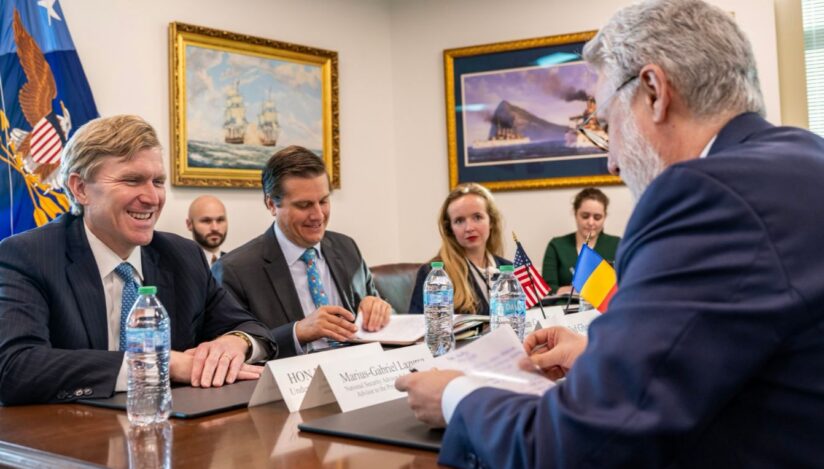
President of Romania Nicușor Dan dispatched Presidential Adviser for National Security Marius Lazurca and Chief of Defence General Gheorghiță Vlad to Washington for consultations with senior U.S. officials and congressional leaders, with Black Sea security and bilateral defense coordination among the stated priorities.
The composition of that Romanian delegation was significant in itself. By pairing the President’s national security adviser with Romania’s senior military leader, Bucharest combined the political-strategic and military levels of the dialogue.
Sursa foto: X
The most consequential publicly confirmed meeting took place at the Pentagon on 29 July with U.S. Under Secretary of War for Policy Elbridge A. Colby. Mr. Colby subsequently stated that he had previewed the U.S. approach to the Europe Posture Review and recognized Romania’s “forward-leaning approach to burden-shifting.” He added: “We agreed that it is time for allies to turn defense spending into real combat capability under NATO 3.0.”
Presidential Adviser Marius Lazurca framed Romania’s message in equally clear terms: “Romania stands with the United States. We met with U.S. officials to deepen our defense commitments and strengthen our shared security on the Black Sea.”
Public accounts of the Washington mission also referenced engagement with congressional leadership, including Senate Armed Services Committee Chairman Roger Wicker, as well as senior administration officials. Senator Wicker’s role matters because, if Chairman Rogers represents the center of gravity for defense authorization and oversight in the House, Chairman Wicker leads the corresponding Armed Services Committee in the Senate.
On the question of U.S. force posture in Europe, Chairmen Rogers and Wicker have already demonstrated a closely aligned concern: burden-sharing should increase, but changes in U.S. posture should be deliberate, coordinated and sequenced with the real development of European capabilities.
Rogers and Wicker: More Burden-Sharing, but No Premature Deterrence Gap
Chairmen Rogers and Wicker publicly opposed the decision to discontinue the rotational U.S. brigade in Romania and argued that major changes to the American force posture in Europe should follow rigorous review, coordination with military commanders and the Joint Staff, and consultation with Congress and Allies.
Their position is important because it shows that the U.S. debate cannot be reduced to a simple binary between “America stays in Europe” and “America leaves Europe.” The central question is how to rebalance responsibilities without weakening deterrence during the transition.
In May 2026, Chairmen Rogers and Wicker argued that, even as Allies move toward higher defense spending, “translating that investment into the military capability needed to assume primary responsibility for conventional deterrence will take time.” They warned that prematurely reducing the American forward presence could undermine deterrence and suggested that forces withdrawn from elsewhere in Europe could instead be positioned further east, where Allies have invested substantially in hosting U.S. forces.
Senator Wicker reiterated that logic in August after Russian attacks and incursions affecting NATO Allies, including Romania. His formulation was concise: “It will take time to translate this spending into military capability.” The ongoing posture review, he argued, must account for that reality.
In this framework, Romania becomes an important case study for how Washington may reconcile two goals: a larger European share of the defense burden and a credible U.S.-backed deterrence posture on NATO’s Eastern Flank.
From Washington to NATO, and then to Bucharest
Following the Washington mission, Presidential Adviser Lazurca continued discussions with the United States and Allied counterparts in the NATO and SHAPE environment. The public message was that Romania is prepared to do more, and to do so faster, within a more balanced sharing of responsibilities across the Alliance.
This sequence is important. Romania did not approach the discussion only with a request for continued U.S. presence; it sought to articulate a national position on the future American posture in Europe and to support that position through direct engagement with the Pentagon, Congress and NATO.
In the current U.S. strategic environment, an argument built exclusively around the proposition that “Romania needs more American troops” is unlikely to be sufficient.
The more relevant question in Washington is increasingly: what can an Ally contribute so that the United States and NATO can generate greater security, resilience and combat power with the resources available?
The Europe Posture Review is therefore not only about troop numbers. It also concerns Allied defense investment, deployable capabilities, access, basing, mobility, operating rights, sustainment and the extent to which European Allies can assume a larger share of conventional defense responsibilities.
Romania’s case must consequently be built on several layers at the same time.
Mihail Kogălniceanu: Romania’s physical strategic argument
Against this background, the choice of the 57th Air Base at Mihail Kogălniceanu for the meeting between President Nicușor Dan and the two members of Congress was especially meaningful.
MK is more than the principal hub of the U.S. military presence in Romania. It is a tangible demonstration of what Romania can provide: strategic geography, infrastructure, access to the Black Sea, proximity to Ukraine, capacity to receive and sustain Allied forces, links to transport networks and long-term expansion potential.
In a posture review that inevitably considers access, basing, logistics and burden-sharing, these assets become strategic arguments.
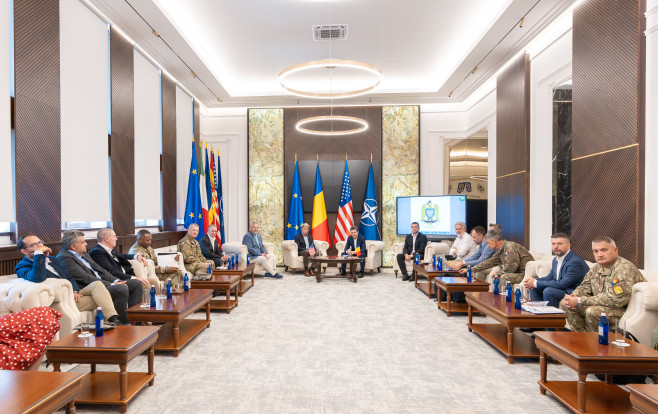
Following the meeting, President Nicușor Dan stated that Romania is “ready to take on a greater share of the responsibility for its own defense” by increasing its commitments and delivering on them. He also highlighted a broad Strategic Partnership agenda encompassing the economy, defense industry, energy, infrastructure, critical minerals and emerging technologies.
The combination of these topics is not accidental. National security is now understood much more broadly than the deployment of military units alone.
An important signal on a more enduring U.S. presence
During the visit to Bucharest, Chairman Rogers publicly indicated that members of Congress were working in support of a more permanent and larger U.S. military presence in Romania within the NATO framework, while also seeking deeper bilateral cooperation in defense industrial production.
This statement should be interpreted with institutional precision. The Chairman of the House Armed Services Committee does not unilaterally decide the deployment of U.S. forces; force posture remains an executive responsibility in which the President and the Department of War play central roles.
Congress, however, has powerful instruments: authorization, appropriations, statutory conditions and oversight. For that reason, Chairman Rogers’ message carries considerable political and institutional weight, particularly because it is consistent with positions he and Senate Armed Services Committee Chairman Roger Wicker have already advanced in Washington.
For many years, one of Bucharest’s strongest arguments in the security relationship with Washington has been geography: Romania is on NATO’s Eastern Flank, it is a Black Sea state, and it is in direct proximity to Ukraine.
Romania can no longer build its case on geography alone
All of this remains true. It is no longer sufficient.
In the emerging U.S. strategic equation, an Ally’s relevance will also be measured by what it can produce, sustain, host, finance and deliver operationally.
That is why Under Secretary Colby’s emphasis on turning defense expenditure into “real combat capability” matters so much. It captures the direction of the debate: inputs remain important, but outputs are becoming decisive.
Romania’s task is to convert its favorable geography into deployable military capability, resilient infrastructure, industrial capacity and concrete value for Allied operations.
Why the Defense Industrial Base has moved to the center of the relationship
For Chairman Rogers, rebuilding the defense industrial base is one of the defining issues of the FY2027 NDAA.
His diagnosis has been unusually direct. In April 2026, he warned: “We are no longer capable of manufacturing for our warfighters at scale or speed.” In July, during debate on the FY2027 NDAA, he summarized the principle behind the legislation in one sentence: “Peace through strength doesn’t begin on the battlefield – it begins in our factories, depots, and shipyards.”
Representative Sorensen’s work on Rock Island Arsenal reinforces the industrial dimension of the delegation. His focus on public-private partnerships, advanced manufacturing, workforce and the Army’s organic industrial capacity reflects the same broader reality: production capacity has become a national-security capability.
For Romania, this creates an opportunity. The country should not present itself to Washington only as a purchaser of American defense equipment.
Romania can seek to position itself as an Allied industrial platform: for co-production, maintenance and sustainment; the integration of Romanian companies into U.S. and transatlantic supply chains; technology transfer; component manufacturing; and the growth of ecosystems around autonomous systems, sensors, communications, electronics and other emerging defense technologies.
This also explains why the delegation’s economic discussions, including engagement with Romania’s Ministry of Finance, should not be treated as an appendix to the defense agenda. American investment, production capacity in Romania and Romanian participation in transatlantic supply chains can generate strategic effects alongside economic ones.
The Black Sea: From declared importance to a concrete Security Architecture
The other thread connecting Washington and Bucharest is the Black Sea.
It was one of the stated priorities of the Lazurca–Vlad mission in Washington and became a central subject during the Rogers–Sorensen visit.
The challenge now is to move beyond repeatedly stating that the Black Sea is strategically important. That point is already established. The question is what concrete architecture should follow from that recognition.
Today, Black Sea security encompasses maritime security, integrated air and missile defense, drones and autonomous systems, protection of offshore energy infrastructure, ports, subsea cables and communications, military mobility, logistical corridors supporting Ukraine and the Republic of Moldova, and the protection of commercial routes.
Recent drone incidents also demonstrate how quickly the traditional distinction between an external military threat and an internal-security problem can blur.
It is therefore significant that the congressional delegation engaged not only with Romania’s Ministry of National Defence, but also with the Ministry of Internal Affairs. Resilience in the Black Sea region increasingly requires a whole-of-government architecture.
Economics and Security are Becoming part of the same equation
Another notable feature of the visit was the diversity of the Romanian interlocutors.
The delegation’s agenda extended beyond the Presidency and the Ministry of National Defence to the Ministry of Foreign Affairs, the Ministry of Internal Affairs and the Ministry of Finance, as well as visits to Mihail Kogălniceanu and the 86th Air Base at Borcea.
That breadth says something important about the way strategic competition is increasingly understood in Washington.
Defense, infrastructure, energy, industry, technology and capital are no longer separate files.
A railway line can be an element of military mobility. A commercial port can become a strategic logistics node. A civilian manufacturer can become part of the defense industrial base. An offshore energy project can become critical infrastructure. A company producing drones, sensors, software or electronic components can become part of national resilience.
Romania’s objective of attracting a much larger and more durable U.S. economic presence should therefore also be understood through a security lens. Strategic capital can reinforce strategic alignment.
“NATO 3.0”: Beyond the Label
The expression “NATO 3.0” also appeared in the public discussion following the meeting between Under Secretary Colby and the Romanian delegation.
It is best understood as a formulation used by the current U.S. policy leadership to describe a new stage of transatlantic burden-sharing rather than as the formal title of a NATO doctrine.
The underlying message is nevertheless clear. The United States is not necessarily arguing for a Europe left on its own. It is arguing for a Europe capable of carrying a larger share of conventional defense, while the United States retains critical capabilities and reallocates attention and resources globally.
For Romania, this creates a potentially favorable equation: greater Romanian burden-sharing can strengthen, rather than weaken, the case for a relevant and enduring U.S. presence.
This is also where the views publicly associated with Under Secretary Colby, Chairman Rogers and Chairman Wicker partly converge. The principal difference concerns the pace and sequencing of the transition. Mr. Colby emphasizes a faster transfer of responsibility to European Allies; Chairmen Rogers and Wicker emphasize the danger of reducing American presence before European spending has been converted into operational capability.
Romania needs to understand and work effectively with both dimensions of the debate.
Ultimately, the visit was about Romania’s Strategic Relevance
Viewed as a sequence — Washington, the Pentagon, Congress, NATO, then Bucharest, Mihail Kogălniceanu and Borcea — the visit of the delegation led by Chairman Rogers takes on greater significance.
It was more than another ceremonial reaffirmation of the Strategic Partnership.
It formed part of a broader negotiation over how the transatlantic relationship will function in the years ahead.
Romania seeks a stronger and more enduring U.S. presence. The United States expects a Europe capable of doing more for its own defense.
Those two objectives are not incompatible. Romania’s strategy should be built around their convergence.
Romania should be able to demonstrate that it can host and sustain American forces; invest credibly in its own defense; build and protect the infrastructure needed for Allied operations; generate and maintain capabilities; contribute meaningfully to Black Sea security; integrate Romanian industry into the transatlantic defense industrial base; and become a multiplier of U.S. and NATO power on the Eastern Flank rather than only a beneficiary of it.
That may be the strongest argument for the next stage of the Romania–United States Strategic Partnership: not simply that Romania occupies strategically important geography, but that it can transform that geography into strategic capability.
Romania needs a more consistent presence in Washington
There is also an institutional conclusion that goes beyond this particular visit.
At a time when U.S. security policy is changing rapidly and decisions on force posture, burden-sharing, industrial priorities and resource allocation are being shaped simultaneously at the White House, the Department of War, the Department of State and on Capitol Hill, Romania needs a more consistent, sustained and multidimensional presence in Washington.
This should not be understood merely as a question of formal diplomatic representation. It requires continuous political, military, congressional, expert and industrial engagement around clearly defined Romanian strategic objectives.
It is not enough to intervene when a decision affecting Romania has already reached its final stage.
Romania needs to be present while options are still being developed, arguments are being tested and priorities are being defined.
That means sustained dialogue not only with the U.S. Administration, but also with members of Congress, relevant committees and their professional staffs, the defense and national-security community, think tanks, and the industrial ecosystem that contributes — directly or indirectly — to the formation of U.S. policy.
Romania’s objectives must be explained continuously, in language adapted to the debate in Washington. We need to be able to state clearly what Romania seeks, why that objective is relevant to the United States, and — most importantly — what Romania itself can contribute to achieving it.
On U.S. force posture, for example, the argument cannot stop at Romania’s desire for a larger American presence. Bucharest must explain the value it offers in return: access, infrastructure, host-nation support, defense investment, operational capability, Black Sea security, industrial capacity and the ability to support U.S. and Allied operations at lower strategic and financial cost.
The same logic applies to defense industry, emerging technologies, energy, critical infrastructure and military mobility. Romania must increasingly move from presenting needs to presenting strategic value propositions.
This engagement must also be agile enough to keep pace with change. The current international environment no longer permits six-month or one-year policy-update cycles. Strategic priorities can shift within weeks as new legislation, budget pressures, operational developments and political decisions create new constraints or new windows of opportunity.
Bucharest therefore needs the institutional capacity to update its positions rapidly and to communicate those updates in Washington while choices are still open.
Being present in Washington today means more than being represented. It means being part of the conversation before the decision.
The Washington mission of Presidential Adviser Marius Lazurca and Chief of Defence General Gheorghiță Vlad, followed by the direct dialogue with Chairman Mike Rogers and Representative Eric Sorensen in Romania, are important steps in that direction.
They should, however, be part of a broader and continuous mechanism.
In a period of profound transformation in the transatlantic relationship, influence will increasingly belong to states that are present, understand change early, explain their interests clearly and can quickly formulate a credible contribution.
For Romania, the objective should not be merely to be informed about decisions made in Washington. The objective should be to be present in the discussions from which those decisions emerge.
Leave A Comment