Land of Ideas. Contact us

Political Research Group at IPSA 2026 in São Paulo: Contributing to the Debate on the Reconfiguration of the International Order
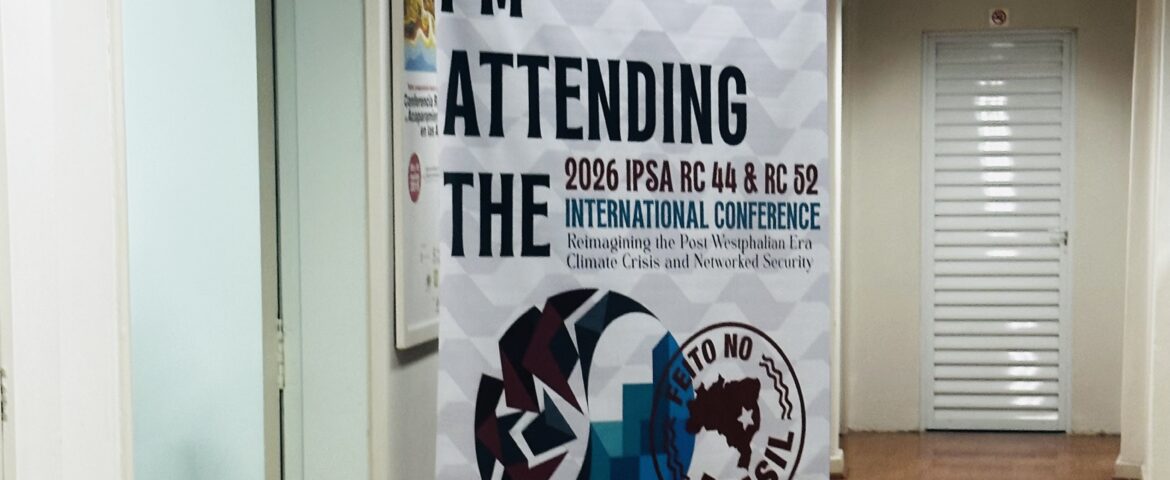
Dr. Liliana Grosaru-Filip presented research on strategic competition, fragmentation and complex security environments at the IPSA RC44 & RC52 International Conference.
Political Research Group (PRG) was represented in São Paulo by Dr. Liliana Grosaru-Filip, President of PRG and Secretary of IPSA Research Committee 24 – Armed Forces and Society, at the 2026 IPSA RC44 & RC52 International Conference, held from 3 to 6 August 2026. Her contribution focused on the structural transformation of the international order and the way strategic competition, institutional fragmentation and interconnected security risks are redefining the global environment.
The conference, titled “Reimagining the Post-Westphalian Era: Climate Crisis and Networked Security”, was jointly organized by IPSA Research Committee 44 – Security, Conflict and Democratization and Research Committee 52 – Climate Security and Planetary Politics, together with the Institute of Public Policies and International Relations of São Paulo State University (IPPRI/UNESP) and the San Tiago Dantas Graduate Program in International Relations (UNESP, UNICAMP and PUC-SP). The event combined online panels on 3 August with in-person sessions in São Paulo from 4 to 6 August.
The programme addressed a broad range of issues shaping contemporary security and global governance, including multipolar competition, regional conflicts, hybrid and cyber threats, democratic resilience, climate security, changing alliance patterns, institutional innovation and emerging transregional architectures. Particular attention was also given to the growing role of the Global South, South-South cooperation and alternative formats of international coordination.
A world order between de-structuring and reconfiguration
Dr. Grosaru-Filip presented the paper “The Contemporary World Order between De-structuring and Reconfiguration: Strategic Competition, Fragmentation, and Complex Security Environments”, published in the conference Book of Abstracts with Political Research Group – Bucharest, Romania, as the institutional affiliation.
The research starts from the premise that the international system is undergoing a double transition. The first dimension concerns the weakening of the hegemonic liberal order built around the United States, a process driven not only by the redistribution of material power but also by deliberate policies of contestation and de-structuring. The second concerns the emergence of a more fluid, competitive and difficult-to-govern environment in which the rules, institutions and relationships that structured the post-Cold War period are increasingly contested or reinterpreted.
Rather than treating the current transformation simply as a movement from unipolarity to multipolarity, the paper argues for a deeper analytical lens: the emergence of a polycentric and fragmented international order. In this setting, established global institutions increasingly coexist with regional organizations, minilateral formats, ad hoc coalitions, technological ecosystems and economic networks that exercise strategic influence alongside states.
This transformation also changes the meaning of security. Military threats can no longer be assessed in isolation from economic coercion, technological dependence, information operations, cyber vulnerabilities, critical infrastructure risks, climate pressures and societal resilience. The resulting security environment is therefore not only more competitive, but also more interconnected, where disruptions in one domain can rapidly generate consequences in others.
Bringing a Romanian perspective into an increasingly global debate
PRG’s participation in São Paulo contributed a Romanian perspective to an academic debate that is increasingly shaped by the interaction between traditional Western institutions and the growing political, economic and strategic weight of actors from Latin America, Asia, Africa and the wider Global South.
The São Paulo setting was particularly relevant to this discussion. The conference agenda explicitly included debates on BRICS+ alternatives, South-South cooperation, South American security cooperation, multilateral reform and new forms of governance experimentation. These questions are becoming increasingly important as states seek more flexible institutional arrangements and as geopolitical competition intersects with trade, technology, critical resources and security partnerships.
For Political Research Group, the participation also reflects a broader institutional objective: connecting academic research with policy-oriented analysis and strengthening Romania’s visibility in international debates on security, global order, strategic competition and emerging geopolitical architectures. The organization’s work increasingly examines the intersection between geopolitical transformation, defence and security, technology, resilience and international economic competition.
Leave A Comment