Land of Ideas. Contact us

BRICS 2026 and the Negotiated Reordering of the International System
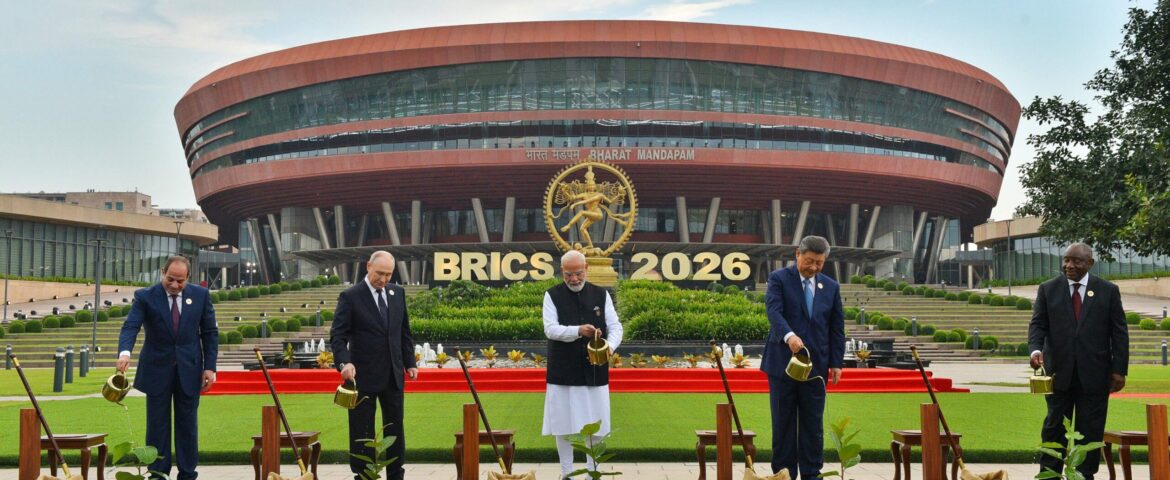
New Delhi did not inaugurate a new world order. It showed how a more plural distribution of power is generating institutions, financial mechanisms, technological ecosystems and political coalitions through which the existing order is being progressively renegotiated.
By Liliana Grosaru-Filip
It is within this wider transformation that New Delhi should be understood. BRICS is often described through two opposing and equally incomplete interpretations: one presents the grouping as the institutional nucleus of an emerging anti-Western order that will eventually displace the architecture created under American and European predominance, while the other dismisses it as an incoherent collection of states whose political differences are too profound to generate meaningful cooperation. The empirical reality displayed in New Delhi suggests a more complex trajectory. BRICS has neither become a coherent geopolitical bloc nor remained merely a diplomatic forum; rather, it is evolving into a dense network of institutions, policy mechanisms, financial arrangements, technical platforms and sectoral coalitions through which major emerging powers seek simultaneously to reform existing institutions, reduce strategic dependencies and create additional centres of international rule-making.
This evolution can be located within a substantial body of International Relations scholarship concerned with the transformation of the post-Cold War order. Amitav Acharya’s concept of a “multiplex world order” is especially useful because it moves beyond the assumption that the decline of unipolarity must simply reproduce nineteenth-century multipolarity. In Acharya’s account, the emerging system is more decentralised and pluralistic, but remains deeply interconnected, containing multiple actors, institutions and normative projects that coexist and interact rather than one hegemonic centre imposing a relatively uniform conception of order.[1] Oliver Stuenkel approaches a similar transformation through the idea of a post-Western or parallel order, in which emerging powers frequently do not seek to abolish established institutions but to complement them with additional institutions that expand autonomy and reduce dependence on structures in which Western states retain disproportionate influence.[2]
Julia Morse and Robert Keohane’s concept of contested multilateralism provides another relevant analytical lens: actors dissatisfied with existing rules can challenge them not by abandoning multilateralism, but by using established institutions differently or by creating new ones whose practices, membership or purposes compete with those of incumbent organisations.[3] Kai He’s concept of institutional balancing similarly captures the use of multilateral institutions to manage power asymmetries and expand strategic room for manoeuvre without necessarily resorting to traditional alliance balancing.[4] Recent scholarship specifically on BRICS reinforces this interpretation. Mihaela Papa and Zhen Han describe the grouping as evolving through “compensatory layering”, in which successive bargains add institutional layers in areas where consensus is possible while preserving informality where it remains politically useful.[5]
Seen through these theoretical lenses, the 2026 summit becomes more significant than the conventional reading of a leaders’ communiqué would suggest. BRICS simultaneously advocates reform of the United Nations, IMF, World Bank and WTO while developing the New Development Bank, payment arrangements, financial-risk mechanisms, technology networks, industrial platforms and development-oriented institutions of its own. This is neither straightforward institutional replacement nor simple integration into the existing order; it is a form of negotiated reordering in which states increasingly operate across overlapping institutional structures and seek the capacity to choose among them.
“We must transform this “pyramid of privilege” into a “platform of partnership”.”
Narendra Modi, opening remarks, 18th BRICS Summit, New Delhi, 12 September 2026 [8]
From an economic acronym to an architecture of emerging-power cooperation
The historical evolution of BRICS mirrors the transformation of the international system itself. The term BRIC was introduced by Goldman Sachs economist Jim O’Neill in 2001 as an analytical category referring to Brazil, Russia, India and China and their prospective contribution to global growth; it contained no institutional or geopolitical project. Political coordination followed only later, with ministerial consultations beginning in the middle of that decade and the first leaders’ summit being held in Yekaterinburg in 2009. South Africa subsequently joined, turning BRIC into BRICS. The 2008 global financial crisis was a critical contextual event because it exposed a growing mismatch between the economic weight of emerging powers and their influence over the institutions responsible for global financial governance.
The first major institutional response came at the Fortaleza Summit in 2014 with the creation of the New Development Bank and the Contingent Reserve Arrangement. Neither displaced the World Bank or IMF, yet both demonstrated that dissatisfaction with existing institutions could generate additional institutional capacity rather than merely rhetorical demands for reform. The New Development Bank, in particular, remains BRICS’ most mature organisational innovation, and its growing emphasis on local-currency financing is central to the grouping’s attempt to reduce structural financial dependencies without formally withdrawing from the global financial system.
A second transformation came through enlargement. Egypt, Ethiopia, Iran and the United Arab Emirates entered the expanded grouping in 2024, while Indonesia joined in 2025. Indian presidency materials in 2026 also listed Saudi Arabia among the eleven BRICS members, although Reuters continued to report that Riyadh had been invited but had not formally completed accession. This discrepancy should be acknowledged rather than obscured because it illustrates the comparatively fluid institutional character of BRICS enlargement. A further ten countries participate as BRICS Partner Countries, extending the political orbit of the format across Asia, Africa, Latin America and the Middle East.[6][12]
Expansion has substantially increased the group’s demographic, economic, geographic and resource base, but it has simultaneously deepened what may be described as a cohesion–representation dilemma. A smaller grouping could coordinate more easily but represented a narrower portion of the Global South; an enlarged BRICS carries far greater representational weight but includes states with sharply different strategic interests. India and China retain an unresolved territorial dispute while also maintaining a vast trading relationship. Iran and the UAE approach Gulf security from different positions. Russia has a structurally confrontational relationship with the Western security order, while India and the UAE maintain extensive partnerships with Washington and Europe. Brazil and South Africa support reform of global governance without necessarily embracing the Russian conception of systemic confrontation.
The organisation therefore remains fundamentally different from a traditional alliance. There is no collective-defence commitment, no unified military planning, no common foreign policy and no supranational authority. Its significance instead lies in the ability to coordinate a heterogeneous set of states that preserve different geopolitical alignments while sharing an interest in increasing the institutional weight of emerging and developing economies. This heterogeneity is not an accidental feature of BRICS; it is one of the main explanations for both its reach and its limits.
New Delhi 2026: global-governance reform and the institutionalisation problem
India’s 2026 presidency was organised around the theme “Building for Resilience, Innovation, Cooperation and Sustainability” and was deliberately pragmatic in its design. More than four hundred ministerial, parliamentary, administrative, business, academic and expert-level engagements were convened in approximately thirty Indian cities, demonstrating that contemporary BRICS cooperation now resides in a dense infrastructure of specialised tracks rather than solely in annual leaders’ meetings.[7] The political centrepiece was the New Delhi Declaration, a wide-ranging document covering global governance, security, finance, trade, development, technology, energy, climate policy, infrastructure, health, labour, education and people-to-people cooperation.
The declaration commits members to the pursuit of a “more representative, fairer international order” and a “reinvigorated and reformed multilateral system”, while simultaneously reaffirming the United Nations Charter and the central role of the UN. This formulation matters because it shows that the official BRICS position is not the rejection of multilateralism; it is a challenge to the historical distribution of authority within multilateralism. In other words, the central dispute is increasingly about representation, agenda-setting power and rule-making rather than the very existence of international institutions.[7]
Modi articulated this position more directly than the formal declaration. He described global governance as a pyramid in which power and decision-making remain concentrated at the top while countries most affected by global crises remain underrepresented in decision-making. He proposed that BRICS develop ten proposals for global governance reform and convert them into a BRICS Reform Roadmap by the next summit, organised around three principles: representation, responsiveness and rule-making. The most important conceptual element of his intervention was the argument that the Global South should move from being a rule-taker to becoming a rule-shaper.[8]
“We must work to transform the Global South from rule-takers into rule-shapers.”
Narendra Modi, 18th BRICS Summit, New Delhi, 12 September 2026 [8]
This language is politically significant because it captures the combination of revisionism and restraint that characterises India’s approach. New Delhi is not advocating the abandonment of global rules; it is contesting the concentration of authority over the process through which those rules are produced. The distinction also helps explain why India can simultaneously demand substantial reform of the United Nations and Bretton Woods institutions while remaining deeply integrated into those institutions and into Western economic and security networks.
Modi also proposed a BRICS Continuity and Implementation Mechanism through which the BRICS Troika would systematically track initiatives across successive presidencies, supported by a digital repository recording responsible institutions, timelines and implementation status. This should be treated accurately as an Indian proposal rather than as a fully established permanent BRICS secretariat. Nevertheless, the declaration itself recognises the need for stronger continuity and long-term institutional development and welcomes progress on a BRICS Online Archival Database. The significance is organisational: rotating chairmanships often produce policy discontinuity, and the creation of monitoring, archival and implementation mechanisms is precisely how informal forums begin to acquire institutional memory.[7][8]
The declaration’s treatment of the United Nations extends this logic. BRICS again called for comprehensive reform of the Security Council and increased representation of developing countries from Africa, Asia and Latin America; China and Russia reiterated support for the aspirations of Brazil and India to play a greater role within the United Nations, including the Security Council. The wording remains deliberately cautious and falls short of an unconditional commitment to a specific permanent-seat formula, yet the political direction is clear: legitimacy is increasingly being associated with representativeness.[7]
The same argument is directed at the Bretton Woods institutions. BRICS calls for IMF quota and governance reforms that better reflect countries’ relative weight in the contemporary global economy, seeks higher quota and voting shares for emerging and developing economies, and demands more transparent and geographically representative leadership procedures in the IMF and World Bank. Yet the declaration simultaneously describes a strong, quota-based and adequately resourced IMF as central to the global financial safety net and defends a reformed WTO-centred multilateral trading system. This combination supports G. John Ikenberry’s argument that the erosion of American primacy does not necessarily imply the disappearance of the deeper institutional logic of an open and rules-based order, since rising powers may seek greater authority inside and alongside those institutions rather than simply destroy them.[6]
Geoeconomics: payments, development finance, industrial capacity and technological sovereignty
The strongest evidence that BRICS is becoming relevant to the reorganisation of international order lies less in its rhetoric about multipolarity than in the proliferation of mechanisms addressing the infrastructures through which economic power is exercised. Contemporary geoeconomics is increasingly shaped not only by GDP or trade volumes, but by control over payment systems, reserve currencies, insurance, digital networks, technological standards, industrial ecosystems, supply chains, energy infrastructure and strategic raw materials. New Delhi devoted considerable attention to precisely these areas.
The issue of de-dollarisation offers an important example of the need to distinguish political narrative from institutional reality. The summit created no BRICS common currency, proposed no common central bank and established no monetary union. What exists is a more incremental strategy of diversification. The BRICS Payment Task Force is examining interoperability between payment and financial-messaging channels and mechanisms for faster, cheaper and safer cross-border transactions, while the declaration records continued discussion of trade settlements and investments in local currencies and explicitly acknowledges that there is no one-size-fits-all approach.[7]
The strategic significance therefore lies not in an imminent replacement of the dollar but in the construction of transactional optionality. If trade can increasingly be settled in national currencies, if payment systems can interoperate across a wider range of channels, if local-currency lending expands and if financial messaging becomes less dependent on any single infrastructure, states acquire greater resilience to political disruption and sanctions without needing to create a rival reserve currency. This is a classic expression of institutional balancing: dependence is reduced by creating alternatives rather than by severing participation in the existing system.
The New Development Bank remains central to this effort. The summit encouraged the NDB to expand resource mobilisation, diversify funding, increase local-currency financing and enlarge its membership, while a BRICS-NDB Knowledge Portal has been launched to preserve development experience, policy innovations and results from NDB-financed projects across successive presidencies. Work also continues on a New Investment Platform, while India has proposed a BRICS Risk Lab at GIFT City and members have discussed a BRICS Insurance Resilience Centre and a multilateral-guarantees initiative intended to mobilise private capital and lower financing costs. None of these mechanisms constitutes a parallel financial order in itself, but their cumulative effect is to create a broader ecosystem of development finance, guarantees, risk assessment and settlement options.[7]
The technological dimension is even more consequential. The New Delhi Declaration characterises digital and ICT ecosystems as critical infrastructure and supports a more sovereign and self-reliant digital environment within BRICS. India proposed a Digital Public Infrastructure Repository for BRICS countries, together with pilot projects that could transfer digital-public-infrastructure solutions across participating states. This reflects India’s own experience in building interoperable public digital systems and, at the same time, demonstrates how digital architecture is becoming a source of geopolitical and normative influence.
Artificial intelligence occupied a prominent place in both the declaration and the interventions of individual leaders. BRICS committed itself to advancing work on global AI governance with particular attention to accessibility, security, reliability, inclusiveness, energy efficiency and the interests of developing economies. Xi Jinping’s intervention on the second day of the summit moved beyond general principles by presenting a set of initiatives for “Greater BRICS” cooperation in artificial intelligence, trade and investment facilitation, the digital economy, smart manufacturing and talent development. Chinese official reporting described the Global South as a central force in world multipolarity and called on BRICS to become an active, stabilising and positive force in international affairs.[9][10]
“The Global South, with its collective rise, has become a key driver of world multipolarity.”
Xi Jinping, Session II of the 18th BRICS Summit, New Delhi, 13 September 2026 [9]
China also announced its intention to take the lead in creating a BRICS AI Open Source Zone, promoted a partnership among special economic zones and proposed a BRICS Forum on Trade in Services during its 2027 chairmanship. The significance of these initiatives extends beyond the technology sector. Control over AI models, training resources, computational capacity, digital identity systems, telecommunications, industrial data and technical standards can generate structural power that is not captured by conventional military indicators. The contest over international order is therefore increasingly occurring through technological ecosystems as well as diplomatic institutions.
Industrial cooperation reinforces this trend. The summit welcomed the operationalisation of the BRICS Centre for Industrial Competencies, developed with UNIDO to support manufacturing companies and SMEs adopting Industry 4.0 technologies, and welcomed the establishment of an India Centre for BRICS Industrial Competencies. Under the Partnership on the New Industrial Revolution, BRICS welcomed a BRICS Incubator Network, strengthened the Startup Knowledge Hub and Startup Forum, and continued consideration of a proposed BRICS Startup Innovation Fund. The distinction between institutions already operational and initiatives still under consideration is analytically essential, because the political ambition of BRICS frequently advances faster than implementation capacity.[7]
Energy and critical minerals further reveal the geoeconomic logic of the summit. New Delhi welcomed BRICS Guiding Principles on Smart Grids and Energy Storage and an Indian initiative for a BRICS Digital Centre of Excellence for Smart Grids and Energy Storage, while cooperation on hydrogen value chains and interoperable standards continues. More consequentially, the declaration calls for reliable, diversified, resilient and fair critical-mineral supply chains, explicitly emphasising value addition and economic diversification in resource-producing countries. Modi reinforced the strategic nature of this issue by warning of the dangers created by the weaponisation of technology and critical minerals.[7][13]
The underlying political economy is significant. Mineral-producing states increasingly resist a model in which extraction takes place domestically while processing, intellectual property and high-value manufacturing remain concentrated elsewhere. The BRICS language on value addition therefore reflects a broader Global South demand not simply for market access but for a more advantageous position within global production networks.
Connectivity, health and technical standards add further layers. BRICS has developed technical requirements for evaluating a high-speed communications network based on submarine-cable connectivity among member countries, adopted a Logistics Supply-Chain Cooperation Framework, advanced rail and urban-mobility networks, and established a sub-working group to develop an Integrated Early Warning System for Mass Infectious Diseases. Cooperation among national standards bodies is also expanding. These initiatives are less visible than major geopolitical declarations, yet they are precisely the mechanisms through which what Karen Alter and Sophie Meunier call international regime complexity is produced: a crowded international environment containing overlapping and partially competing institutions, rules and technical systems.[7][14]
Three strategic visions inside BRICS: India, China and Russia
New Delhi simultaneously demonstrated that increasing institutional density does not eliminate the fundamental political differences among the principal BRICS powers. Those differences will determine whether the grouping evolves primarily as a reformist coalition, a platform for strategic autonomy or a more explicitly counter-hegemonic project.
India occupies a pivotal position because its foreign policy does not fit comfortably within traditional alliance categories. It is simultaneously a BRICS member and a Quad participant, a close partner of the United States and European Union, a long-standing strategic partner of Russia and a geopolitical competitor of China. This posture is better captured by the concept of multi-alignment than by either classical non-alignment or alliance politics: New Delhi seeks cooperation with different power centres while preserving sufficient strategic autonomy to avoid dependence on any one of them.
For India, BRICS is therefore valuable precisely insofar as it strengthens the voice of the Global South and creates institutional alternatives without becoming an instrument of Chinese primacy or a vehicle for a Russian-Western geopolitical rupture. This helps explain the reformist emphasis of the Indian presidency: greater representation in established organisations, diversified financial and technological capacity, resilient supply chains and more development cooperation, combined with continued commitment to the UN, IMF, WTO and other universal institutions.
The Modi–Xi bilateral in New Delhi illustrates this complexity. Xi’s visit was his first to India in seven years and took place against the background of an unresolved Himalayan border dispute and the rupture generated by the 2020 confrontation. Nevertheless, the two leaders sought to stabilise relations and discussed trade imbalances, market access, supply-chain concerns and the broader strategic relationship. Chinese official reporting described their agreed direction in unusually clear language: “China and India are partners rather than rivals, and development opportunities rather than threats to each other.”[11] Modi, for his part, continued to stress that peace and tranquillity along the border remain fundamental to broader normalisation. This is best described as competitive interdependence: strategic rivalry, economic interaction and institutional cooperation occur simultaneously rather than sequentially.
“China and India are partners rather than rivals, and development opportunities rather than threats to each other.”
Xi Jinping, meeting with Narendra Modi, New Delhi, 12 September 2026 [11]
China’s broader BRICS vision is more explicitly ecosystem-oriented. Xi called for “Greater BRICS” to strengthen industrial and supply-chain integration, build connected markets and expand cooperation in AI, digital industry, intelligent manufacturing and talent development. Beijing appears to view the grouping not simply as a forum for political coordination, but as a possible architecture connecting technology, industrial policy, standards and markets. The central question for the 2027 Chinese presidency will be the degree to which other members, and India in particular, accept deeper integration without increasing their structural dependence on Chinese technology and industrial capacity.
Russia approaches BRICS from a different strategic position. Western sanctions, the restructuring of Russian trade and Russia’s confrontation with the Euro-Atlantic security order provide Moscow with considerably stronger incentives to accelerate the construction of mechanisms insulated from Western financial and political leverage. During the summit, Putin presented BRICS as a force contributing to a fairer and more multipolar world order, a formulation consistent with the Russian view that the present international system is already undergoing a systemic transition.[12]
“BRICS is becoming a powerful driving force in the creation of a new, more just and multipolar world order.”
Vladimir Putin, remarks at the BRICS Summit, as reported by Reuters, 13 September 2026 [12]
The difference in emphasis among New Delhi, Beijing and Moscow is analytically important. Russia is the most explicitly revisionist of the three because it seeks greater insulation from Western institutions; China remains deeply integrated into the world economy but increasingly seeks to shape the institutional and technological environment in which that economy operates; India wants a redistribution of influence and greater strategic autonomy without exchanging one hierarchy for another. BRICS therefore contains not one theory of international order but several partially overlapping projects.
The wider Global South: diplomacy, security and the limits of cohesion
The Middle East crisis provided one of the most difficult tests of this heterogeneous architecture. Iran is a BRICS member, while the United Arab Emirates maintains extensive security and economic relations with the United States. The summit nevertheless produced common language expressing concern over escalation, calling for maximum restraint, protection of civilians, respect for sovereignty, diplomatic solutions, freedom of navigation and continuity of energy and commercial flows. The diplomatic achievement was not the originality of these formulations, but the fact that states positioned differently within an active regional confrontation accepted a common declaration.[7][15]
The summit also created space for direct regional diplomacy. Iranian President Masoud Pezeshkian and Abu Dhabi Crown Prince Sheikh Khaled bin Mohamed bin Zayed met on the margins of the summit in the highest-level encounter between the two sides since the present crisis began. India held intensive bilateral consultations with both sides. This demonstrated a genuine convening capacity, even though BRICS still lacks the political cohesion and security instruments required to enforce a settlement in a major conflict. The distinction is essential: BRICS can create diplomatic space, but it does not yet possess collective-security capacity.
Pezeshkian’s own intervention illustrated the more revisionist economic demands present within the expanded grouping. He called for stronger political, economic and technological coordination, resistance to unilateral sanctions and the establishment of a permanent BRICS secretariat in order to improve implementation. He also argued for economic and financial relations less dependent on what he described as monopolistic instruments. These proposals go further than the Indian preference for preserving BRICS’ relatively flexible institutional character and therefore expose an internal debate over how far formal institutionalisation should proceed.[16]
“To enhance efficiency and accelerate implementation, measures such as resisting unilateral sanctions … and establishing a permanent secretariat are necessary.”
Masoud Pezeshkian, 18th BRICS Summit, New Delhi, 12 September 2026, as cited by Anadolu/Tasnim [16]
South Africa supplied a different emphasis. President Cyril Ramaphosa used the summit’s second day to call for a more ambitious BRICS agenda extending from science, technology and innovation to sustainable development and economic transformation, while linking inclusive growth to climate change, inequality and the rapid development of artificial intelligence. His intervention is representative of a strand of BRICS thinking that is less focused on confrontation with Western institutions than on increasing the developmental agency of emerging economies.[17]
“The 20th anniversary of BRICS is a moment to reaffirm our commitment to deeper cooperation and a more ambitious agenda.”
Cyril Ramaphosa, BRICS Partners and Outreach Session, New Delhi, 13 September 2026 [17]
These differences explain why the organisation should not be interpreted as a conventional geopolitical bloc. BRICS cohesion is often issue-specific: its members may agree that global governance is insufficiently representative, that payment and supply-chain resilience should increase, or that the Global South requires greater developmental autonomy, while disagreeing substantially over security alignments, relations with the United States, the desirable pace of de-dollarisation, territorial conflicts or the degree of formal institutionalisation. Its effectiveness will therefore depend on whether it can turn selective consensus into durable institutional cooperation without demanding a degree of strategic uniformity that its members are unwilling to provide.
Europe and Romania in a more plural institutional order
For the European Union, the most important lesson from New Delhi is that BRICS cannot be understood adequately through a binary “West versus anti-West” framework. Treating every demand for institutional reform as geopolitical alignment with Beijing or Moscow risks reinforcing precisely the perception that BRICS discourse seeks to exploit: that the structures of global governance remain resistant to the changed demographic and economic weight of the emerging world.
The challenge for Europe is simultaneously institutional, economic and regulatory. The New Delhi Declaration opposes carbon-border measures considered unilateral, punitive, discriminatory or protectionist, a formulation directly relevant to developing-country criticism of the European Union’s Carbon Border Adjustment Mechanism. From a European perspective, CBAM is principally a climate-policy instrument designed to prevent carbon leakage; from the perspective of many emerging economies, it can appear as a regulatory cost designed elsewhere and transferred onto their industrialisation. The disagreement therefore concerns not only the substance of climate policy but the procedural legitimacy of international rule-making: who participated in designing a rule, whose development constraints were considered and who bears the costs of implementation.[7]
The strategic issue is broader. If standard-setting, critical-mineral value chains, AI governance, digital public infrastructure, industrial policy and financial architecture increasingly become arenas of geopolitical competition, Europe will need to complement regulatory power with deeper investment, technology partnerships and institutional engagement across the Global South. The European Union retains formidable assets — market size, scientific capacity, finance, regulatory expertise and deep international partnerships — but these assets will generate durable influence only if partner countries see European frameworks as channels for shared development rather than solely as compliance systems.
India should occupy a particularly important place in this European strategy because it is among the powers most capable of operating simultaneously within Western and non-Western institutional networks. Its trajectory embodies Acharya’s multiplex order particularly clearly: New Delhi can participate in the Quad, deepen its relationship with the European Union, preserve energy and defence links with Russia, negotiate competitively with China and simultaneously present itself as a political voice for the Global South.
For Romania, none of this implies ambiguity regarding fundamental geopolitical orientation. Romania remains firmly anchored in NATO, the European Union and the strategic relationship with the United States. What should evolve is the breadth of its strategic analysis and economic diplomacy. A European state can remain securely embedded in Western institutions while recognising that an increasing share of global growth, manufacturing capacity, technology development and political influence is located in countries that reject exclusive bloc alignment.
India is especially relevant because its technological, industrial, defence, space and digital capabilities intersect with areas in which Romania seeks to develop greater capacity, including defence innovation and dual-use technologies, artificial intelligence, cyber security, critical infrastructure, advanced manufacturing, energy systems, space applications, data centres and digital connectivity. Romanian engagement with India should therefore be understood not merely as bilateral trade promotion, but as part of a broader adaptation to the geoeconomic geography of the twenty-first century.
Conclusion: reordering without replacement
The 18th BRICS Summit did not create a new world order, and the institutional evidence does not support claims that BRICS has already displaced Western leadership. The dollar retains its central role in international finance, Western capital markets remain structurally dominant, the IMF and World Bank possess resources and legitimacy that BRICS institutions do not yet match, NATO has no equivalent as a military alliance, and the United States and European Union continue to exercise substantial technological, financial and regulatory power.
Yet it would be equally mistaken to conclude that the structure of international order remains essentially unchanged. What New Delhi revealed is a gradual movement from demands for greater representation toward the construction of mechanisms that can make greater autonomy materially possible. Payment interoperability, local-currency financing, development banking, multilateral guarantees, insurance cooperation, industrial-competency centres, startup networks, digital public infrastructure, AI cooperation, smart-grid mechanisms, critical-mineral strategies, logistics networks, public-health warning systems and technical-standard coordination appear modest when examined individually; when understood as elements of a cumulative process, they form an increasingly dense institutional ecosystem around BRICS.
This development resembles neither the construction of a completely separate international order nor simple integration into the existing one. Acharya’s multiplex framework explains why different institutional orders can coexist and overlap; Morse and Keohane’s contested multilateralism clarifies how new organisations and arrangements can pressure established ones without replacing multilateralism itself; Kai He’s institutional balancing captures the strategic value states derive from creating institutional alternatives; and Papa and Han’s compensatory layering explains why incremental institutional growth may become significant even without a centralised BRICS bureaucracy.
The most consequential demand emerging from New Delhi is therefore not that the existing international system should be destroyed, but that the historical concentration of authority over its rules should end. Modi’s formulation that the Global South should move from rule-taker to rule-shaper captures both the revisionism and restraint of this project: it contests the distribution of authority without rejecting the principle that international politics should remain organised around rules and institutions.
For this reason, multipolarity alone may ultimately be an insufficient description of the emerging system. What is developing is not simply a world containing a larger number of powerful states, but a world containing a larger number of centres of institutional initiative, regulatory ecosystems, financial pathways and technological architectures. States increasingly cooperate in one institutional setting while balancing one another in another; alliance relationships coexist with economic interdependence, and strategic competition coexists with sectoral cooperation.
The contest over the next international order will consequently concern more than the distribution of military capabilities. It will concern who provides development finance, which payment infrastructures are used, who controls strategic supply chains, whose technical standards become accepted internationally, which AI and digital architectures spread across markets, which institutions can offer credible crisis-management mechanisms and, ultimately, who has the authority to define the rules within which others must operate.
New Delhi did not mark the replacement of the post-war international order. It demonstrated something subtler and potentially more consequential: a transition from an order in which a relatively narrow group of states possessed disproportionate agenda-setting power toward one in which institutional authority itself is progressively negotiated, fragmented and pluralised. BRICS is not the sole author of that transition, nor is its success guaranteed; its internal contradictions, asymmetries and consensus-based structure will continue to limit collective action, while China’s economic preponderance may itself generate new balancing behaviour among members. Nevertheless, dismissing the grouping either as an anti-Western slogan or as an ineffective diplomatic club would miss the institutional transformation beneath the rhetoric.
The international system is not being replaced overnight. It is being renegotiated institution by institution, rule by rule and infrastructure by infrastructure.
Selected academic references and primary sources
[1] Amitav Acharya, “After Liberal Hegemony: The Advent of a Multiplex World Order,” Ethics & International Affairs, 2017; see also The End of American World Order, Polity.
[2] Oliver Stuenkel, Post-Western World: How Emerging Powers Are Remaking Global Order, Polity, 2016; and The BRICS and the Future of Global Order.
[3] Julia C. Morse and Robert O. Keohane, “Contested Multilateralism,” The Review of International Organizations, 2014.
[4] Kai He, “Institutional Balancing and International Relations Theory,” European Journal of International Relations, 2008.
[5] Mihaela Papa and Zhen Han, “The Evolution of Soft Balancing in Informal Institutions: The Case of BRICS,” International Affairs, 2025.
[6] G. John Ikenberry, “The End of Liberal International Order?”, International Affairs, 2018.
[7] Prime Minister of India, “BRICS New Delhi Declaration: Building for Resilience, Innovation, Cooperation and Sustainability,” 12 September 2026, pmindia.gov.in.
[8] Prime Minister of India, “PM’s Opening Remarks during the 18th BRICS Summit Session: Inclusive Global Governance and Strengthening Multilateralism,” 12 September 2026, pmindia.gov.in.
[9] Embassy/Ministry of Foreign Affairs of the People’s Republic of China, “President Xi Jinping Attends Session II of the 18th BRICS Summit and Delivers an Important Statement,” 13 September 2026.
[10] Reuters, “Xi pushes ‘Greater BRICS’ economic ties to give bloc larger global role,” 13 September 2026.
[11] Ministry of Foreign Affairs of the People’s Republic of China, “President Xi Jinping Meets with Prime Minister Narendra Modi of India,” 12 September 2026.
[12] Reuters, “Xi pushes ‘Greater BRICS’ economic ties to give bloc larger global role,” 13 September 2026; Reuters background on BRICS expansion, 12 September 2026.
[13] Associated Press, “At BRICS, India’s Modi warns geopolitical tensions and supply chain shocks threaten global stability,” 13 September 2026.
[14] Karen J. Alter and Sophie Meunier, “The Politics of International Regime Complexity,” Perspectives on Politics, 2009.
[15] Reuters, “Iran and UAE back joint BRICS statement urging restraint in war,” 12 September 2026.
[16] Anadolu Agency, “Iranian president urges BRICS to establish permanent secretariat, resist unilateral sanctions,” 12 September 2026, citing Pezeshkian’s summit remarks/Tasnim.
[17] Presidency of the Republic of South Africa, “Statement by President Cyril Ramaphosa during the Session on Shaping the Future for Inclusive Global Growth,” 13 September 2026.
Editorial note: The analysis distinguishes between initiatives formally adopted or operationalised, mechanisms welcomed by the summit, and proposals still under consideration. Where official Indian documentation and international reporting differ on Saudi Arabia’s membership status, the discrepancy is explicitly acknowledged.
Leave A Comment